ISAC in 3GPP
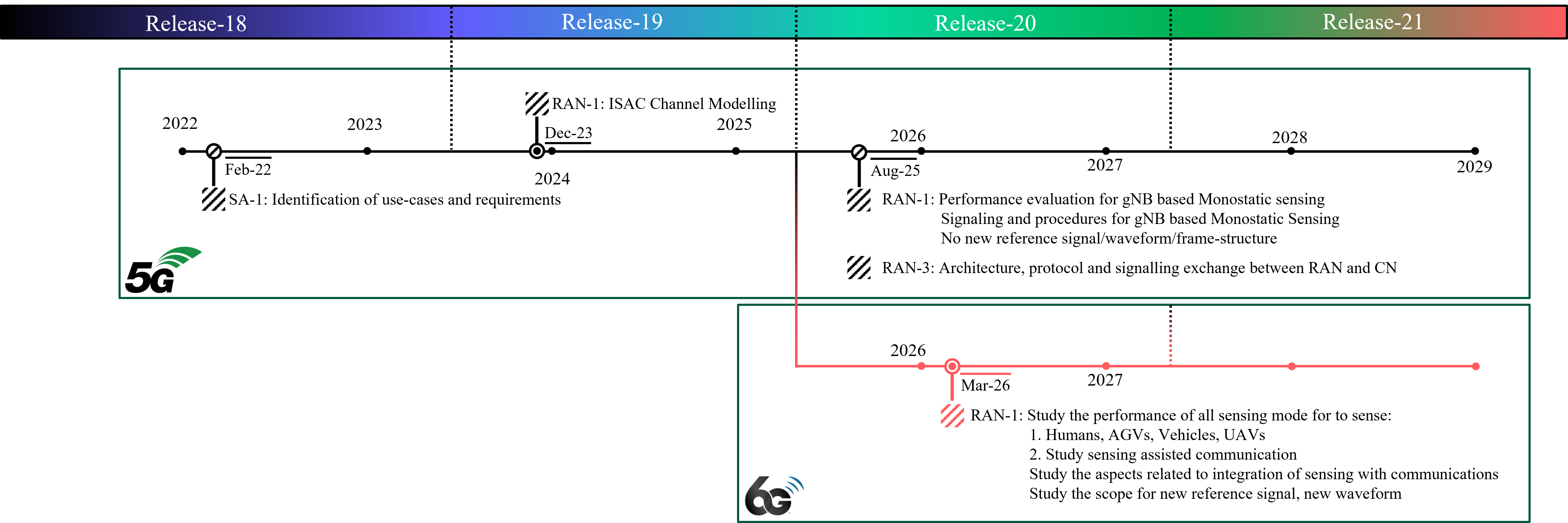
1. ISAC Standardization in 5G
1.1 Use-case Identification of ISAC in 3GPP
The standardization of Integrated Sensing and Communication (ISAC) within the 3rd Generation Partnership Project (3GPP) was initiated in February 2022. The primary objective was to enable sensing functionalities using 5G New Radio (NR) infrastructure. Initial work in the Service and System Aspects (SA1) Working Group focused on identifying use cases and defining system requirements, covering both network-based and user equipment (UE)-based sensing.
These early efforts established a foundation by outlining applications and requirements needed to extend 5G systems for ISAC services across multiple domains and industries.
1.1.1 Object Detection and Tracking
A fundamental ISAC capability enabling:
Intrusion detection in homes and industries
UAV detection and monitoring
Crowd tracking for public safety
1.1.3 Environmental Monitoring
Use cases include:
Flood and rainfall monitoring
Disaster management and rescue operations
Smart agriculture
1.1.4 Human-Centric Sensing
Applications include:
Healthcare and vital signs monitoring
Activity recognition
Gesture recognition
Sports and fitness tracking
1.1.5 Public Safety and Security (B2G Applications)
ISAC enables several government-focused applications, including:
UAV detection as an early warning system
Monitoring of critical infrastructure
Crowd management to prevent emergencies
1.2 Channel Modeling and Technical Enhancements
In December 2023, a channel modeling study was initiated within the RAN1 Working Group to develop models suitable for sensing applications, particularly object detection and tracking.
The study covered various targets such as UAVs, vehicles, humans, and hazardous materials across multiple sensing modes and frequency bands ranging from 0.5 GHz to 52.6 GHz. Enhancements to existing 3GPP channel models included:
Radar Cross Section (RCS)
Mobility characteristics
Spatial consistency
These improvements help accurately represent real-world sensing scenarios.
1.3 ISAC Support in Existing 5G Systems
Although ISAC is not inherently standardized in 5G, sensing functionalities can be supported through firmware or hardware adaptations. This is achieved by reusing existing 5G reference signals, including:
Demodulation Reference Signal (DMRS)
Sounding Reference Signal (SRS)
Channel State Information Reference Signal (CSI-RS)
Positioning Reference Signal (PRS)
These signals can serve dual purposes for both communication and sensing. Several proof-of-concept implementations by academia and industry have demonstrated the feasibility of this approach.
1.4 Evolution Toward 5G Advanced
ISAC capabilities are expected to progress significantly in 5G Advanced (Release 20). Key anticipated developments include:
Base station (BS) monostatic sensing
Potential BS-to-BS bistatic sensing
Support for UAV detection using existing NR waveforms
These advancements aim to enable practical sensing solutions, particularly for security and surveillance use cases.
2. ISAC Standardization in 6G
2.1 Formal Inclusion in 6G Standardization
ISAC has been recognized as a fundamental component of future 6G systems. During the 3GPP 6G workshop in March 2025, ISAC was identified as a key enabler for advanced services such as extended reality (XR) and AI-driven applications.
A major milestone occurred in June 2025 at the 3GPP RAN #108 meeting, where ISAC was officially included in the 6G study scope, establishing it as a “Day 1” feature of 6G.
2.2 Vision and Core Capabilities in 6G
In 6G, ISAC is expected to evolve into a core network functionality that tightly integrates communication and sensing. Key research directions include:
Development of sensing-optimized waveforms
Adaptive and flexible resource scheduling
Joint communication and sensing optimization
AI-driven sensing and data fusion mechanisms
2.3 Advanced Sensing Architectures
6G is expected to introduce advanced sensing architectures such as:
Multi-base station coordination to reduce interference
Multi-static sensing involving multiple transmitters and receivers
Active participation of user equipment (UE) in sensing tasks
These architectures will enhance sensing accuracy, coverage, and reliability.
2.4 Expanded Use Cases and Applications
6G ISAC is expected to support a wide range of advanced applications, including:
High-resolution environmental mapping
Fully autonomous transportation systems
Smart cities and infrastructure monitoring
Industrial automation
Immersive extended reality (XR) environments
3. References and 3GPP Documents
The following table provides the URL of the 3GPP documents related to ISAC and some useful references for each ISAC feature. The table will be updated as and when new documents are released by 3GPP and new references are added. The link are attached from the latest version of the documents. Please check the version of the document before referring to it.
3.1 References: 5G
The details of work carried out in 3GPP related to ISAC in 5G-New Radio are as follows:
ISAC Work in 5G-NR: Release-19
The work related to ISAC in 5G started in Release-19 with focus on primarily three aspects:
Stage-1/SA1 (Service Requirements): TR 22.837 Release-19 Study on Integrated Sensing and Communication
Stage-1/SA1: 3GPP TS 22.137 Release-19 Integrated Sensing and Communication.
ISAC Channel Model: TR 3GPP 38.901 (version later than 19.3.0).,
ISAC Work in 5G-NR: Release-20
The work related to ISAC in 5G-New Radio started in Release-20 with focus on:
3.2 References: 6G
ISAC Work in 6G: Release-20
Stage-2/SA2 (System Architecture): 3GPP TS 23.137, Integrated Sensing and Communication; Stage 2 Release 20.
Stage-2/SA2 (System Architecture): 3GPP TR 23.700-14, Study on Architecture Enhancement to Support Integrated Sensing and Communication Stage 2 / SA2 (System Architecture).
Stage-1/SA1 (Service Requirements): 3GPP TR 22.870: Study on 6G Use Cases and Service Requirements Release-20.